
Case study · Personal injury law
94% fewer blog posts. 74% more clicks.
A personal injury law firm had 1,993 blog posts, and only 72 of them had earned even one click in the previous 90 days. We removed the dead weight, merged the duplicates into one strong page each, and rewrote and fact-checked everything that stayed. Seven weeks after launch, the smaller blog was earning 74% more search clicks than the full 1,993-post blog had before.
Real client site. Figures come from the client's own Search Console and site records; the client's name is withheld.
+74%
Blog clicks from Google, from 1,756 to 3,057, seven weeks before launch against seven weeks after.
94% fewer
Published blog posts at launch, from 1,993 to 126. Every post that stayed was rewritten and fact-checked.
−1.3
Average Google position across blog pages, from 9.0 to 7.7. Closer to the top of page one.
The numbers
Blog clicks per week, before and after launch.
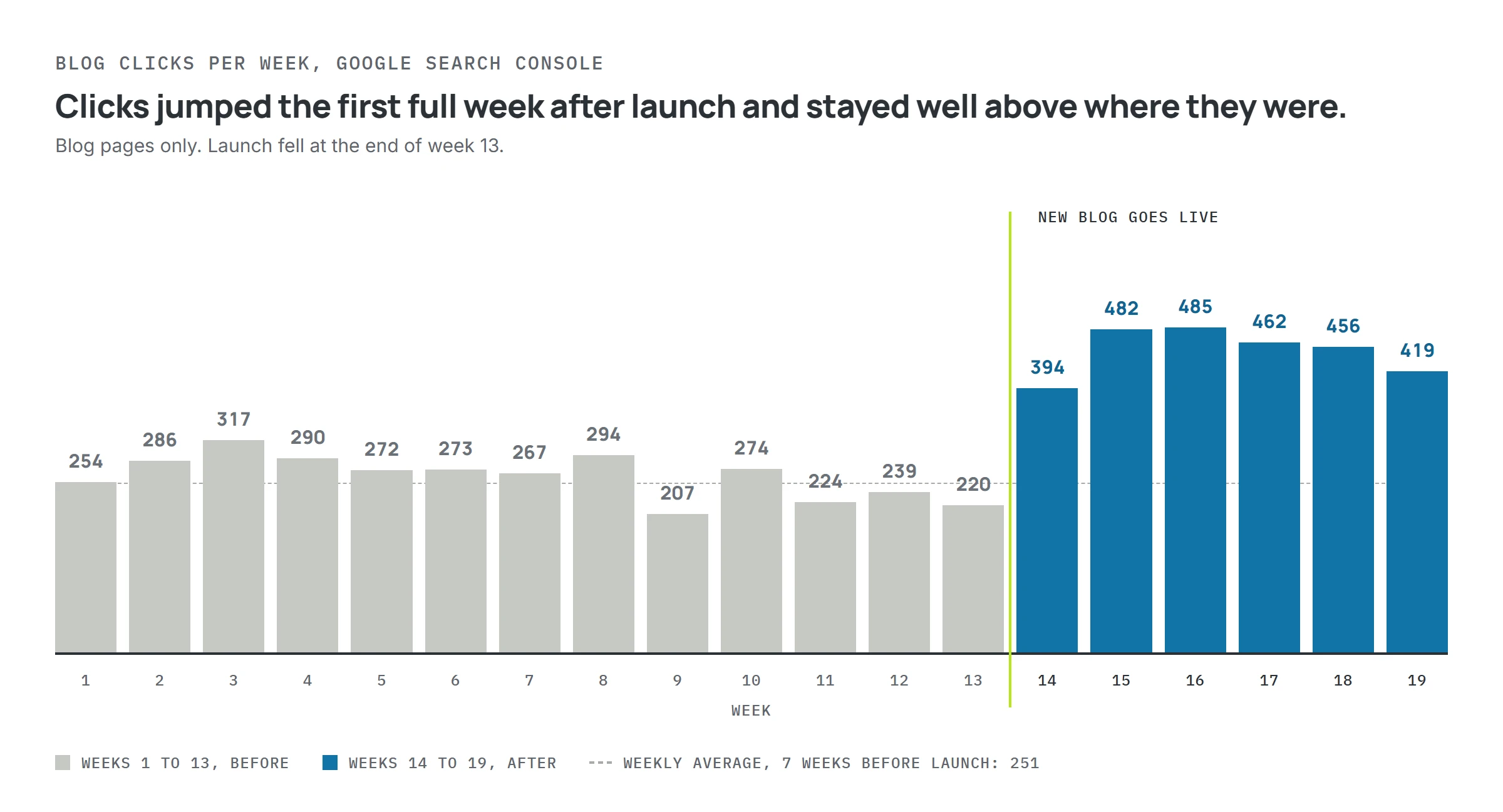
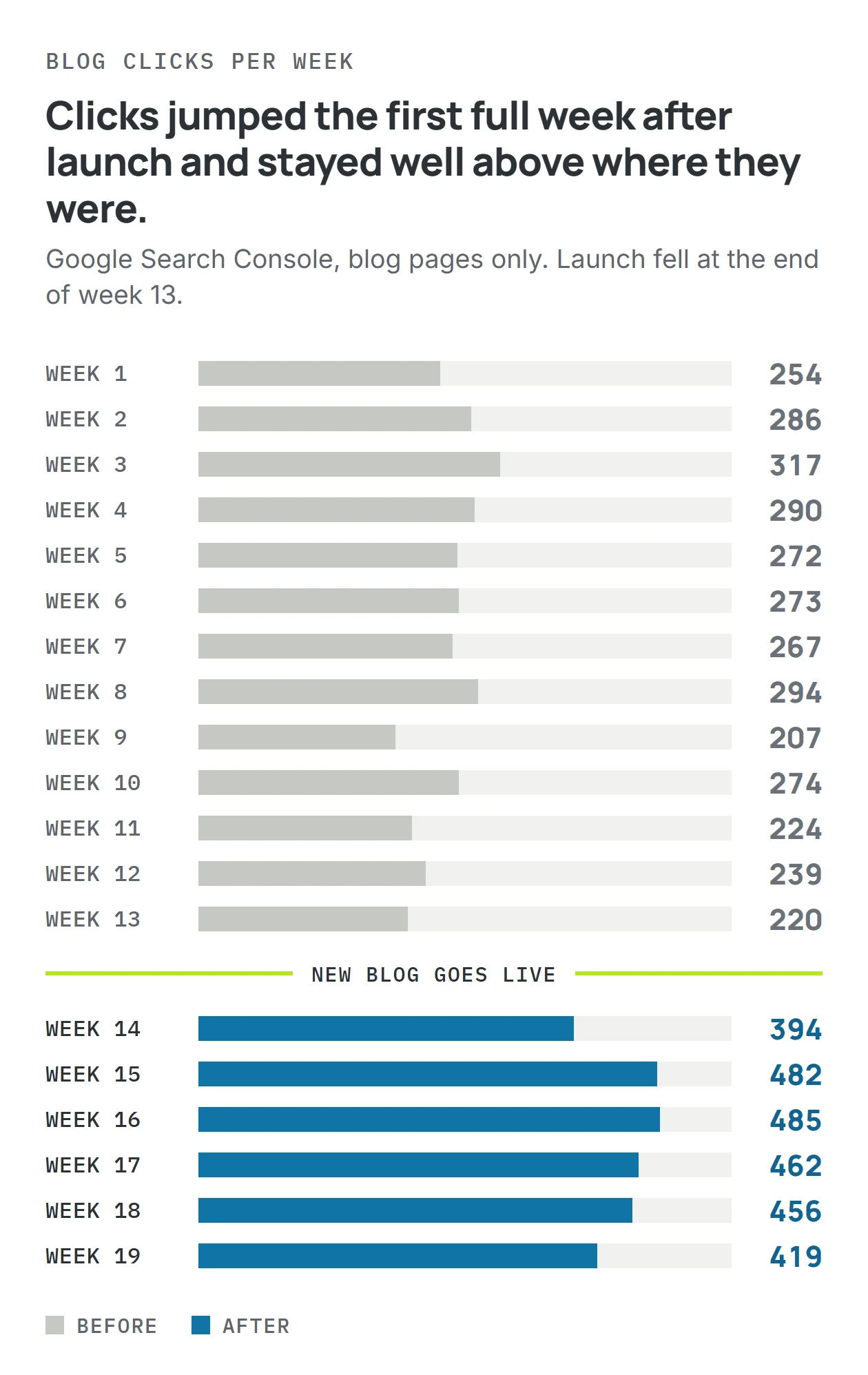
Google Search Console, blog pages only. Launch fell at the end of week 13. Impressions rose from 369,946 to 556,056 over the seven weeks either side of launch. Clicks to the rest of the site rose 12% over the same period, and blog clicks over the same seven weeks a year earlier fell 5%, so the lift was concentrated in the blog.
The challenge
Nearly 2,000 posts. 72 earned a click.
Years of publishing had left the blog huge and uneven. We matched every post against 90 days of Search Console data and keyword demand. 1,921 of the 1,993 posts had zero clicks in that window. 219 covered the same topics as other posts, several articles answering the same question and competing with each other for one ranking.
The posts worth keeping had problems of their own. The firm's brand was written several different ways, statistics were years out of date, some legal statements were wrong for the firm's own state, and some search titles showed broken template text instead of a headline.
Google was crawling a blog where 94% of the pages were noise. The 1,867 posts we removed had produced 0.4% of the blog's clicks in the 90 days before we started.
The work
What we did.
- Scored every post. Clicks, impressions, position, top keyword and search demand for each of the 1,993 posts, with one call per post: refresh, merge, remove or keep. Duplicates were grouped into 33 topic clusters with one keeper each.
- Removed the 1,647 posts that earned nothing. Zero clicks in 90 days, and no reason to keep them in front of Google.
- Merged 220 duplicates into their strongest version. Where a duplicate had something the keeper lacked, we merged the content, then redirected the old URL to the page that won.
- Rewrote all 126 posts that stayed. Fresh keyword research, length set by what actually ranks, FAQ sections with structured data, consistent branding in the post copy, and a keyword-led title and description on every post.
- Fact-checked the law. We checked every post against official sources and fixed more than 500 issues, from legal accuracy to contradictions and clarity. Among them: coverage described as optional that state law makes mandatory, a missing deadline, a page describing the wrong court system, and a closed litigation still headlined as new. We also removed every promise about case outcomes from the blog, since those can run afoul of lawyer advertising rules.
Outcome
The results.
Search Console started moving within days. On the first business day after launch, blog impressions ran about 74% above the pre-launch daily average. By the second full week, blog clicks were close to double the pre-launch weekly average, 482 against 251, and they have stayed well above it since.
Across seven weeks either side of launch, blog clicks rose 74%, from 1,756 to 3,057. Impressions rose 50%, from 369,946 to 556,056, and the average position across blog pages improved from 9.0 to 7.7. Blog clicks over the same seven weeks a year earlier fell 5%, which suggests this is not a seasonal bump.
The gains were broad. Several posts that had been on page two moved onto page one, and most of the top posts already on page one moved up. Whole-site organic clicks rose 55% over the same window, from 2,558 to 3,958, with a fraction of the blog posts to maintain.
Why we think it worked
More content wasn't the answer here. The 1,867 posts we removed had produced 0.4% of the blog's clicks, and the smaller blog now earns more search clicks than the full 1,993-post blog did.
Next step
Different business, same question.
What is your search and paid spend actually producing? We will look, then tell you plainly what we would change first.