
Case study · Pool cleaning and repair
Fix the tracking first. Then the leads scale.
They came to us heading into their busiest season with paid search that had failed to scale and almost no organic visibility. They were also counting phone calls and nothing else, so the form fills and web chats that routinely became paying customers were invisible.
Figures are reported from the client's own accounts and dashboards.
+286%
SEO traffic, once technical issues and site structure were addressed.
+1,846%
Search impressions, as service pages matured and local authority strengthened.
$45
Paid search cost per lead, held steady at scale. Total inbound leads up 337%.
The numbers
Most of the performance problem was a measurement problem.
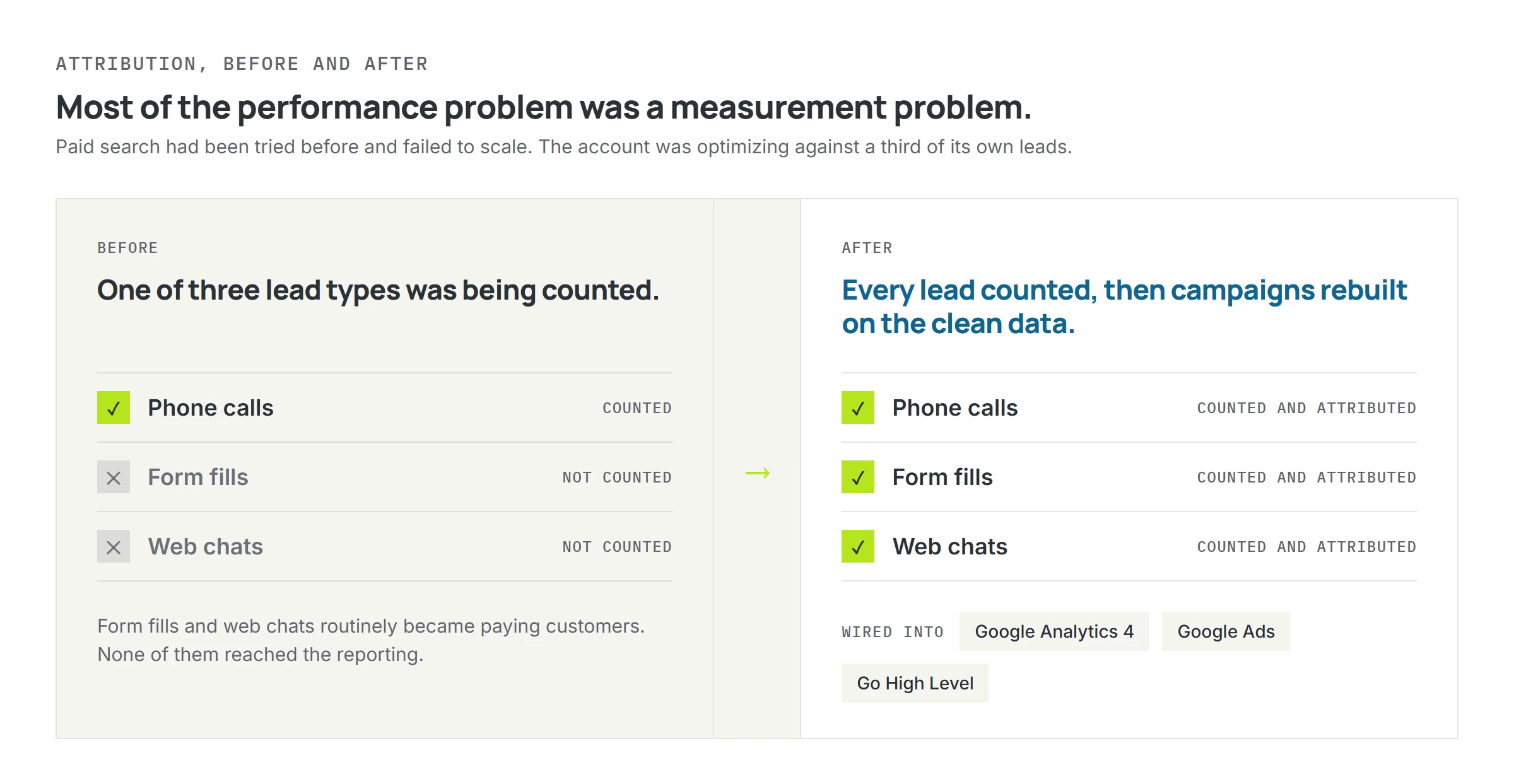
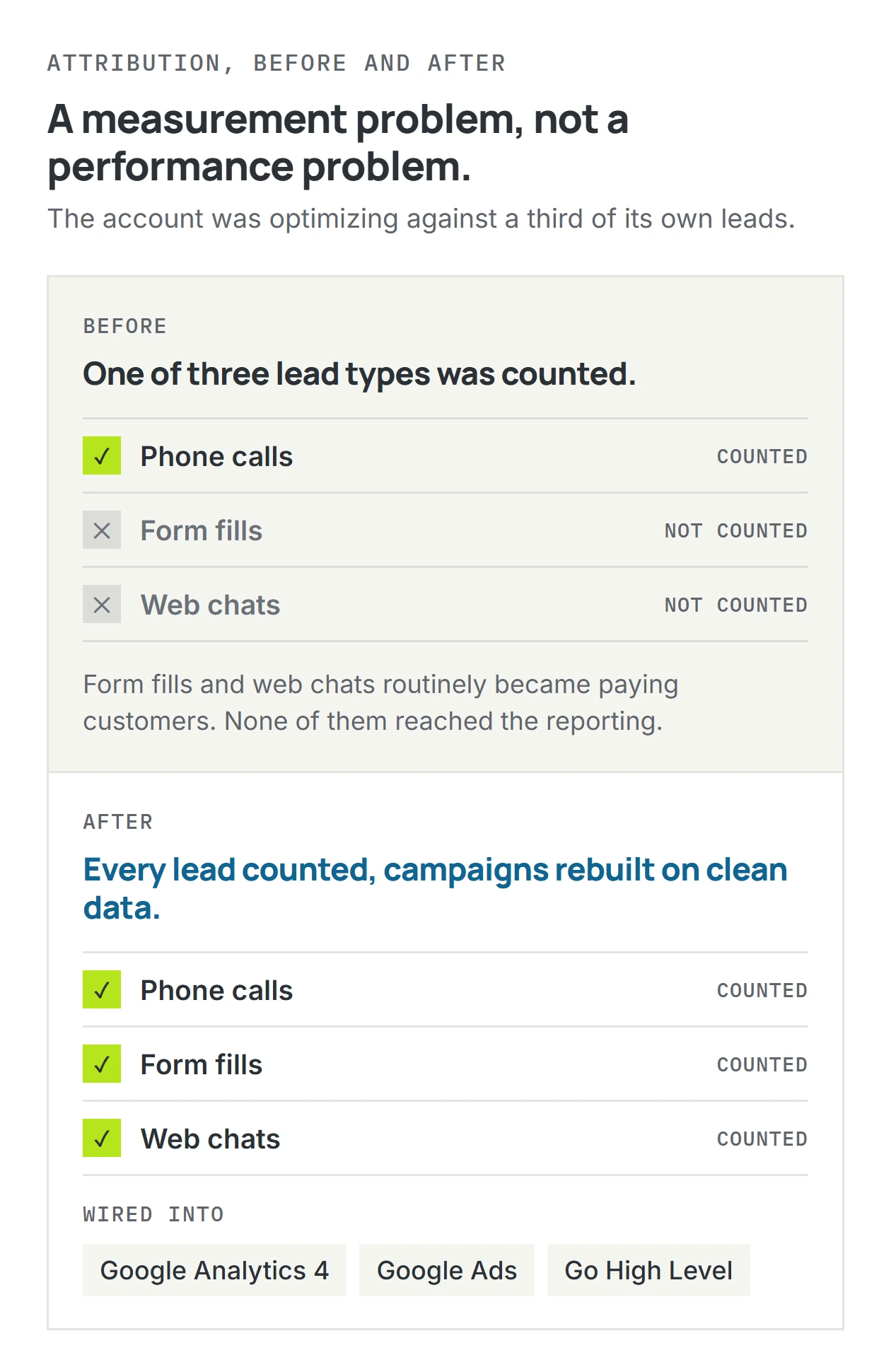
Only phone calls were being counted. Form fills and web chats, which routinely became paying customers, never reached the reporting or the bidding.
The challenge
Two channels stalled, and no way to see why.
Paid search had been attempted before and failed to scale efficiently. Organic visibility was close to nonexistent.
On top of that, only phone calls were being tracked. High-intent form fills and web chats, which routinely converted into paying customers, were ignored entirely. That gave a misleading picture of performance and capped their ability to grow.
They needed a system that could reliably generate qualified leads for monthly pool cleaning and pool repair while keeping acquisition costs under control.
The work
What we did.
- Fixed attribution before spending more. We implemented tracking for phone calls, form submissions and web chats, and connected Google Analytics, Google Ads and Go High Level so every lead could be attributed to the channel that produced it.
- Repaired the SEO foundation. We resolved technical and on-page issues, including pages that were incorrectly canonicalized and could not rank, rebuilt the site structure to reflect the full service offering and service areas, and cleaned up heading hierarchy and internal linking.
- Built the pages the demand actually searches for. Dedicated service pages for pool cleaning, equipment repair, commercial services, new pool startups and city-level coverage, with FAQs on every service page and Service, LocalBusiness and FAQPage structured data.
- Rebuilt the campaigns, then scaled them. Campaigns were rebuilt around high-intent service searches rather than broad terms. Once clean conversion data was in place we introduced Performance Max, which expanded reach while holding lead quality.
Outcome
The results.
Organic traffic rose 286% and search impressions grew 1,846% as site structure, content and local authority matured across priority service areas.
Across the engagement, total inbound leads increased 337%, driven by improved targeting, clean conversion tracking and a scalable campaign structure. Paid search settled at a $45 cost per lead with a consistent inbound flow.
Instead of guessing, they now operate a predictable, measurable acquisition system.
Why it worked
Most of the early performance problems were tracking problems. Service-driven architecture beat generic pages, and Performance Max only worked once clean conversion data was in place.
Next step
Different business, same question.
What is your search and paid spend actually producing? We will look, then tell you plainly what we would change first.