
Case study · Personal injury law
The blog that got rebuilt gained 74%. The one left alone lost 17%.
Two personal injury firms, each with a blog built up over years, measured over the same fourteen weeks. One firm's blog was rebuilt and kept getting a new post every week. The other's stopped getting new posts and was left as it was. Google showed both blogs just as often as before, or more. Only one kept its clicks.
Real client sites. Figures come from each firm's own Search Console; client names are withheld.
+74%
Blog clicks at the firm whose blog was rebuilt, seven weeks after launch against seven weeks before.
−17%
Blog clicks at the firm whose blog was left alone, over the same weeks.
Flat
Impressions on the blog left alone. Google showed it as often as before, just further down the page.
The numbers
One blog climbed. One drifted.
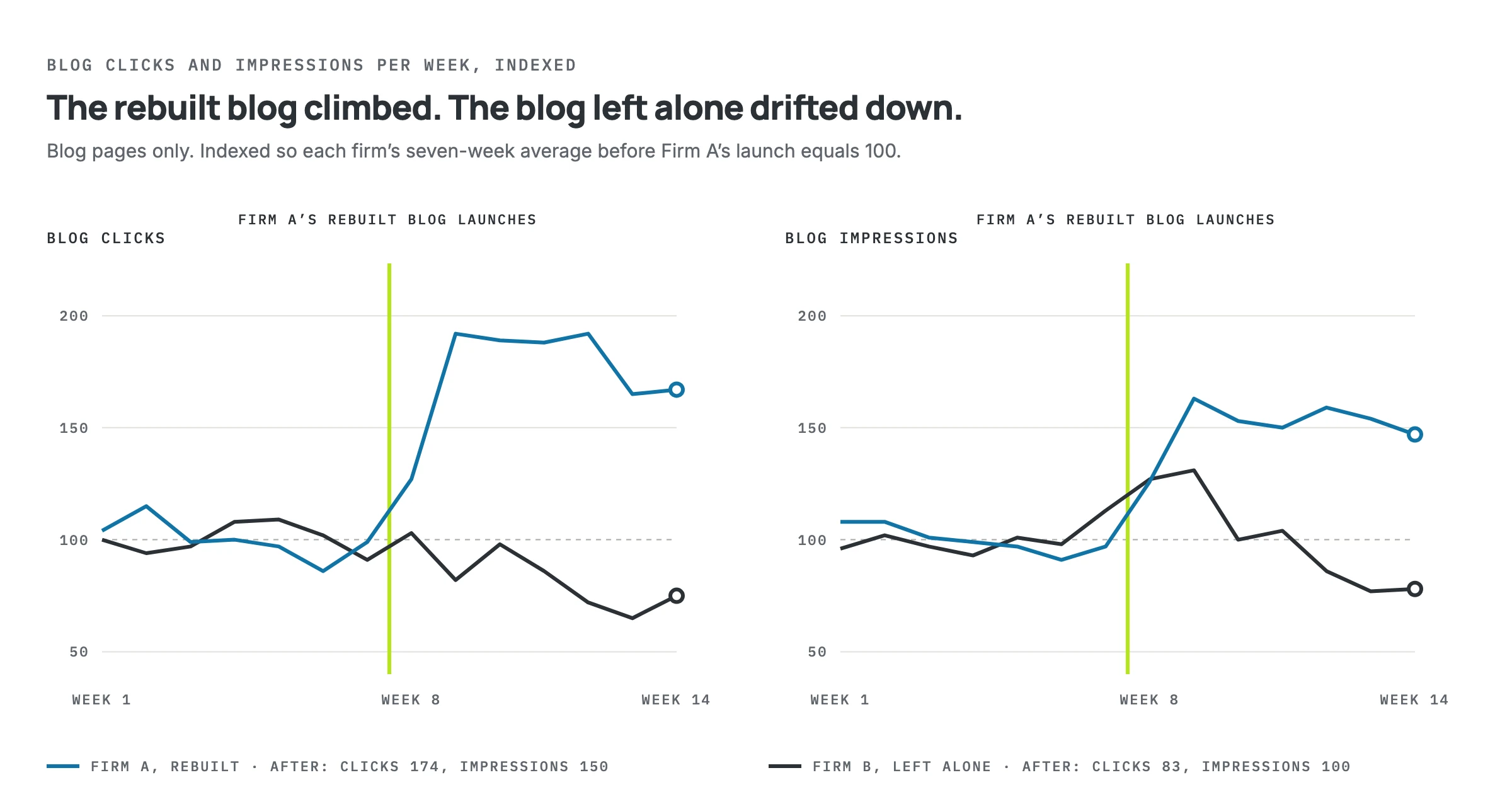
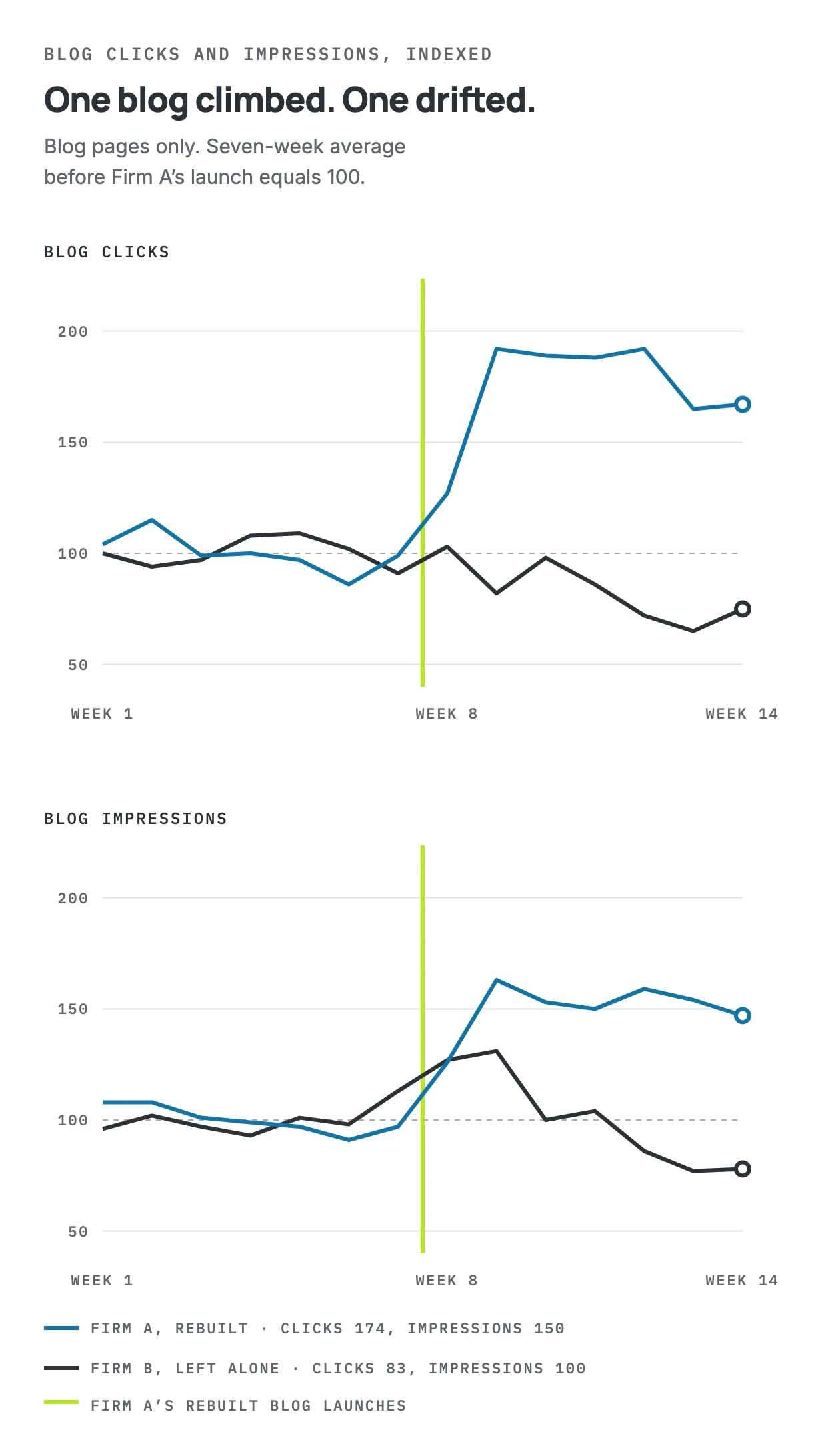
Google Search Console, blog pages only, per week. Each firm is indexed so its own seven-week average before Firm A's launch equals 100, which puts two different-sized blogs on one scale.
The challenge
Most firm blogs get treated as finished.
Law firm blogs are usually built in bursts and then left to sit. The posts stay up, they keep showing in Google for a while, and it is easy to assume they will keep earning on their own.
Both of these firms had years of posts behind them. Firm A's blog had grown to nearly 2,000 posts, and almost none of them had earned a click in the previous three months. Firm B's blog stopped getting new posts in early summer. That gave us two blogs in the same practice area, in the same weeks, run two different ways.
The work
Two blogs, run two ways.
- Firm A: rebuilt, then kept going. We cut the blog to the posts worth keeping, merged duplicates into one strong page each, and rewrote and fact-checked everything that stayed. The full story is in our blog consolidation case study. After launch the blog got one new, researched post every week.
- Firm B: left as it was. No new posts after early summer, and no project on the blog during these weeks.
- Measured side by side. The same seven weeks either side of Firm A's launch, blog pages only, with each firm indexed to its own baseline so the two can be read on one chart.
Outcome
The results.
The rebuilt blog climbed. Over the seven weeks after launch, Firm A's blog earned 74% more clicks than in the seven weeks before, on 50% more impressions, and its average position improved from 9.0 to 7.7.
The blog left alone drifted. Over the same weeks, Firm B's blog earned 17% fewer clicks. Its impressions were flat, so Google was still showing the posts. They were simply ranking lower, with average position slipping from about 12 to about 14, just far enough to cost clicks.
What we are not claiming. Firm A's weekly new posts are still young and earned under 1% of its extra clicks in this window. The lift came from rebuilding what was already there. The weekly posts are what keep the blog moving from here, and we will report on them once they have a few months behind them.
Why it worked
A blog is maintained, not finished. Worked on, it climbs. Left alone, it slides down the page while it still looks busy in the impression count.
Next step
Different business, same question.
What is your search and paid spend actually producing? We will look, then tell you plainly what we would change first.